Admission CRM for Colleges : A Smarter Way to Manage Student Admissions
The admission process is one of the most important functions of any educational institution. From handling student enquiries to managing applications and confirming enrolments, admission teams must coordinate multiple activities while providing a smooth experience for prospective students.
However, managing these activities manually can lead to missed follow-ups, scattered information, delayed responses, and lost admission opportunities.
An Admission CRM for colleges helps educational institutions streamline their admission processes, organise student enquiries, and track prospective students throughout their admission journey.
With the right admission management technology, colleges and universities can improve team coordination, make data-driven decisions, and create a more structured experience for students.
What Is an Admission CRM?
An Admission CRM, or Customer Relationship Management system, is a software solution designed to help educational institutions manage prospective students and their admission journey.
It enables admission teams to maintain student enquiry records, track communication, schedule follow-ups, manage applications, and monitor admission progress from a centralised platform.
Unlike traditional spreadsheets or manual registers, an admission CRM provides a structured approach to managing enquiries and coordinating admission activities.
For colleges, universities, and other educational institutions, it can connect different stages of the admission process, from the first student enquiry to application submission and enrolment.
Why Do Colleges Need Admission CRM Software?
As competition among educational institutions increases, providing timely information and consistent communication can make a meaningful difference to the student experience.
Without a dedicated system, admission teams may struggle to manage enquiries from multiple sources, including websites, digital marketing campaigns, telephone calls, education fairs, and referrals.
An admission CRM helps address these challenges through centralised information and organised workflows.
1. Manage Student Enquiries in One Place
Educational institutions receive enquiries through multiple channels. Keeping track of every prospective student can become difficult when information is spread across different platforms.
An admission CRM helps consolidate enquiry information into a centralised system. Admission counsellors can review student details, preferred courses, enquiry sources, and current follow-up status without depending entirely on separate spreadsheets.
2. Improve Follow-Up Management
A prospective student may need information about course eligibility, fees, scholarships, placements, or application deadlines before making a decision.
Consistent follow-ups help admission teams answer questions and guide students through the decision-making process.
With structured follow-up tasks and reminders, an admission CRM helps counsellors identify pending enquiries and prioritise their next actions.
3. Streamline the Admission Process
Manual admission workflows can involve repeated data entry, disconnected communication, and difficulty identifying incomplete applications.
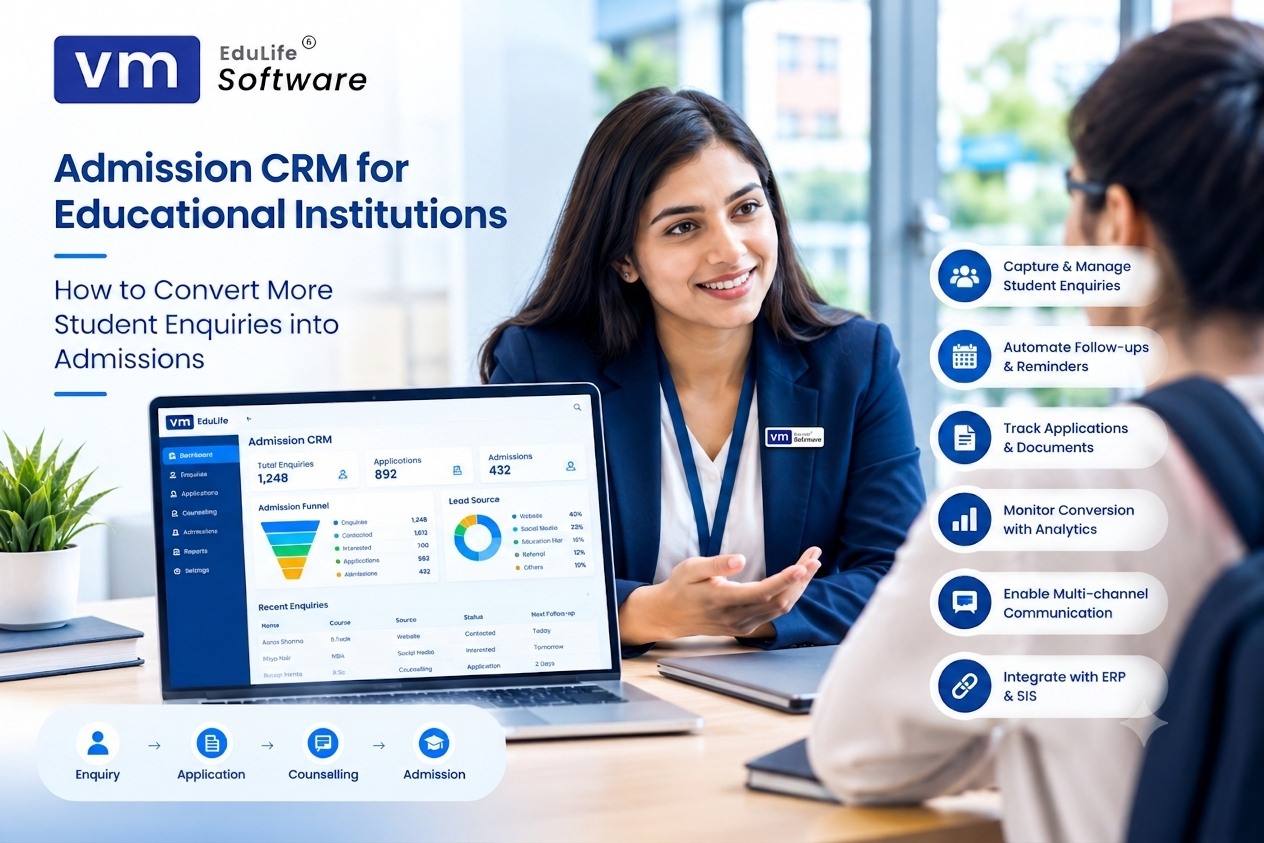
Admission CRM software helps organise the process into defined stages, such as enquiry received, contacted, counselling completed, application submitted, documents pending, and admission confirmed.
These stages can be configured to match an institution’s admission policies and requirements.
4. Monitor Admission Performance
Admission managers need a clear understanding of how enquiries progress towards confirmed admissions.
A suitable CRM can provide reports on enquiry volumes, lead sources, application progress, follow-up activities, and conversion rates.
These insights help management evaluate admission campaigns, identify bottlenecks, and make better-informed decisions about future recruitment activities.
Essential Features of an Effective Admission CRM
When selecting admission CRM software for a college or university, institutions should consider the features that support their day-to-day admission activities.
Centralised Lead Management
Maintain organised records of prospective students, including their contact information, course preferences, enquiry source, and current admission status.
Automated Follow-Up Reminders
Help counsellors keep track of pending calls, scheduled communication, and important admission deadlines through configurable reminders and workflows.
Application Tracking
Monitor application progress, identify missing information, and help admission teams coordinate the next steps in the process.
Admission Funnel Reporting
Review the movement of prospective students through different admission stages to understand where additional engagement or process improvements may be required.
Communication Management
Coordinate student communication through supported channels and integrations. Consistent communication helps prospective students receive relevant information at the appropriate stage of their journey.
Counsellor and Team Management
Assign enquiries to the appropriate team members, monitor outstanding activities, and improve visibility into individual and team workloads.
College ERP Integration
Where supported, integration with a college ERP or Student Information System can reduce duplicate data entry and improve continuity between admissions and student administration.
Together, these capabilities help institutions create a more organised and measurable admission process.
How Admission CRM Helps Improve Student Enrolment?
An admission CRM supports student enrolment by helping institutions manage the steps that occur between an initial enquiry and a confirmed admission.
Consider a prospective student who submits an enquiry through a college website.
The admission team can record the enquiry, assign it to a counsellor, schedule a follow-up, and share relevant course information. As the student progresses, the team can update the enquiry status, track the application, and identify outstanding requirements.
If the student has not completed the application, the counsellor can follow up according to the institution’s process.
This structured approach reduces reliance on memory and manual tracking. It also gives admission managers greater visibility into pending activities and the overall admission pipeline.
The result is a more organised admission workflow that can create better opportunities for student engagement and conversion. Actual improvements depend on enquiry quality, course demand, communication practices, and the effectiveness of the institution’s admission team.
Admission CRM vs. Traditional Admission Management
Many educational institutions begin with spreadsheets and manual registers. These methods may work for small admission volumes, but managing growing numbers of enquiries can become increasingly complex.
An admission CRM offers a more structured alternative.
Traditional methods typically require staff to update records manually, coordinate follow-ups individually, and prepare reports using separate data sources.
Admission CRM software centralises enquiry records, supports organised follow-up activities, and provides a clearer view of admission progress.
A CRM can also help standardise workflows across departments and campuses, subject to the system’s capabilities.
The objective is not simply to replace spreadsheets with software. It is to establish a consistent admission process that helps staff respond to prospective students, manage responsibilities, and identify opportunities for improvement.
How vmedulife Supports Digital Transformation in Admissions?
Educational institutions increasingly need connected digital systems to manage their academic and administrative activities efficiently.
vmedulife offers education technology solutions designed to support the digital needs of educational institutions. Its broader campus management approach can help institutions explore more integrated ways of managing student-related processes.
When evaluating vmedulife for admission management, institutions should consider how the available CRM capabilities align with their requirements for enquiry tracking, follow-up coordination, application management, admission reporting, and integration with existing systems.
A well-planned digital admission process can help institutions establish clearer responsibilities, improve access to information, and support better coordination between admission teams and other administrative departments.
For institutions planning to modernise their operations, admission management can be an important starting point for broader digital transformation.
How to Choose the Right Admission CRM for Your College?
Selecting the right admission CRM requires more than comparing feature lists. Institutions should evaluate how well the software supports their actual admission workflows.
Before making a decision, consider the following questions:
Can the system capture and organise enquiries from your major lead sources?
Does it support your courses, departments, and admission stages?
Can counsellors track pending follow-ups and application progress?
Does it provide useful admission reports and conversion insights?
Can it support multiple campuses or admission teams if required?
Does it integrate with your existing ERP or student information systems?
Are user permissions, data security, and access controls appropriate for your institution?
Does the provider offer implementation guidance, training, and technical support?
A solution that aligns with your institution’s processes can make adoption easier and help your team gain more value from the software.
Frequently Asked Questions About Admission CRM
What is the purpose of an Admission CRM?
An Admission CRM helps educational institutions manage prospective student enquiries, organise follow-ups, track applications, and monitor admission progress through a structured system.
Is Admission CRM useful for colleges and universities?
Yes. Colleges and universities can use admission CRM software to coordinate admission teams, manage enquiries from multiple sources, track prospective students, and improve visibility into the admission pipeline.
Can Admission CRM help increase admission conversions?
An admission CRM can support better conversion opportunities by reducing missed follow-ups, improving enquiry management, and helping teams identify where prospective students need additional assistance. Results depend on how the system is implemented and used.
What is the difference between Admission CRM and College ERP?
Admission CRM primarily focuses on prospective students, enquiries, counselling, applications, and enrolment activities. A College ERP generally manages broader institutional operations, which may include academics, fees, examinations, attendance, and student administration.
Some education technology platforms offer integration between these functions, depending on the available modules.
How does Admission CRM improve counsellor productivity?
It helps counsellors access enquiry information, organise pending tasks, track student communication, and prioritise follow-ups. This can reduce time spent on manual coordination and record keeping.
Conclusion
Managing admissions effectively requires more than generating student enquiries. Educational institutions need a structured process for responding to prospective students, coordinating follow-ups, tracking applications, and monitoring admission performance.
An Admission CRM for colleges provides a foundation for bringing these activities together in a centralised system.
By adopting suitable admission management technology, institutions can improve workflow visibility, strengthen team coordination, and create a more consistent experience for prospective students.
For colleges and universities exploring digital transformation, vmedulife offers an opportunity to evaluate how education technology can support their admission and broader campus management requirements.
Ready to explore smarter admission management for your institution? Visit the vmedulife website to learn more about its education technology solutions and discuss your requirements with the team.