Smart Campus Management System : How Colleges and Universities Can Build a Digitally Connected Campus?
Educational institutions are entering a new era of digital transformation. As student expectations evolve and academic operations become more complex, colleges and universities need smarter ways to manage their campuses.
Traditional methods of handling admissions, student records, examinations, fee collection, faculty administration, and academic activities often involve disconnected systems and manual processes. These challenges can slow down institutional operations, create information gaps, and make management decisions more difficult.
This is where a Smart Campus Management System becomes essential.
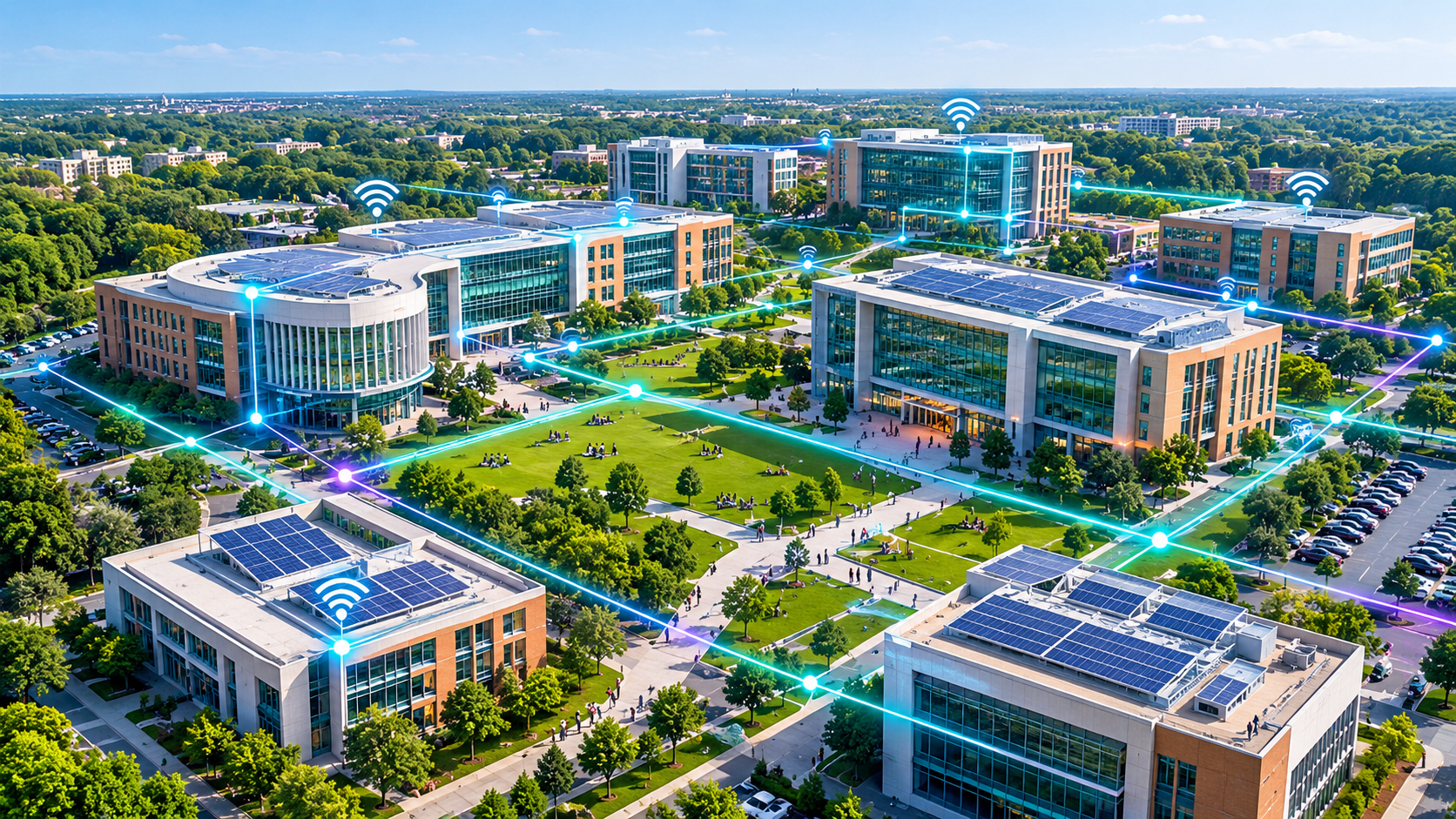
A smart campus brings academic, administrative, financial, and operational activities together through integrated digital technologies. It enables institutions to automate everyday processes, improve communication, access real-time information, and create a better experience for students, faculty, administrators, and management.
With an integrated Education ERP ecosystem like vmedulife, educational institutions can move beyond traditional campus administration and build a connected, efficient, and future-ready digital campus.
What Is a Smart Campus Management System?
A Smart Campus Management System is an integrated digital platform that connects different academic and administrative functions of an educational institution.
It combines technologies such as Education ERP, Student Information Systems (SIS), Learning Management Systems (LMS), examination automation, digital communication, and institutional analytics to simplify campus operations.
Instead of managing individual departments through separate applications, institutions can connect their workflows and information through a unified digital environment.
A smart campus helps educational institutions:
Automate repetitive academic and administrative activities.
Maintain accurate student and faculty information.
Improve coordination between departments.
Digitize examination and assessment processes.
Simplify fee management and financial operations.
Strengthen communication with students and parents.
Monitor institutional performance through digital reports.
Make informed decisions using real-time information.
A smart campus is not simply about introducing technology into an institution. It is about creating a connected environment where people, processes, and information work together.
Why Are Colleges and Universities Moving Towards Smart Campus Solutions?
Managing a modern educational institution involves multiple departments, thousands of records, and numerous interconnected activities.
When these processes depend on spreadsheets, paperwork, and disconnected applications, institutions may experience operational delays and difficulties accessing reliable information.
Some common challenges include:
1. Disconnected Departmental Operations
Admissions, examinations, finance, academics, and administration often work through separate systems. This makes information sharing difficult and creates unnecessary duplication.
2. Time-Consuming Administrative Work
Manual attendance records, examination documentation, fee calculations, and report preparation consume valuable time that could be spent on more important institutional activities.
3. Limited Visibility into Institutional Performance
Without integrated reporting, management may struggle to access accurate information about student performance, attendance, fee collection, faculty activities, and departmental operations.
4. Communication Gaps
Students, parents, faculty members, and administrators need timely information. Traditional communication methods can make it difficult to ensure that everyone receives important updates.
5. Increasing Expectations for Digital Education
Students increasingly expect accessible digital services, online learning resources, transparent academic information, and convenient communication channels.
A Smart Campus Management System addresses these challenges by connecting institutional processes and improving how information moves across the campus.
10 Essential Features of a Smart Campus Management System
A successful smart campus requires more than a collection of digital tools. It needs integrated systems that support the complete institutional lifecycle.
Here are ten essential capabilities educational institutions should consider.
1. Integrated Education ERP Software
Education ERP Software forms the technological foundation of a smart campus.
It connects essential institutional functions, including admissions, student information, academics, examinations, finance, human resources, and administration.
With an integrated ERP platform, colleges and universities can reduce dependency on disconnected applications and manage their institutional activities through coordinated digital workflows.
For management, this means better visibility into departmental activities and more efficient institutional administration.
2. Smart Student Information Management
Students are at the centre of every educational institution. Managing their information efficiently is therefore an essential part of campus digitalisation.
A Student Information System (SIS) maintains student records throughout their academic journey, from admission to graduation.
Important capabilities include:
Digital student profiles.
Admission and enrolment records.
Academic history and semester-wise performance.
Attendance tracking.
Document management.
Student progression records.
Academic reporting.
With organised student information, institutions can reduce paperwork, improve record accuracy, and provide administrators with easier access to essential student data.
3. Digital Learning Management System (LMS)
Learning should not be restricted to physical classrooms.
An integrated Learning Management System enables institutions to extend academic activities into a digital learning environment.
Faculty members can upload learning materials, share assignments, conduct assessments, and support student engagement through online platforms.
Essential LMS capabilities include:
Digital course management.
Learning material distribution.
Online assignments and assessments.
Faculty-student interaction.
Course progress tracking.
Online learning activities.
By connecting digital learning with academic administration, institutions can create a more accessible and flexible learning experience.
4. Automated Examination and Assessment Management
Examination management involves several interconnected activities, from scheduling and hall ticket generation to evaluation and result declaration.
Manual handling of these activities can increase administrative workload and create opportunities for errors.
An Examination and Assessment Management System helps institutions digitise important examination processes, including:
Examination scheduling.
Question paper management.
Hall ticket generation.
Seating arrangements.
Internal and external assessments.
Marks entry and result processing.
Grade cards and transcripts.
On-screen evaluation and result analysis.
For autonomous colleges and universities, examination automation can improve coordination, documentation, and the overall efficiency of assessment operations.
5. Smart Fee Management and Financial Automation
Fee collection is one of the most important financial operations within an educational institution.
Managing multiple fee structures, payment schedules, instalments, outstanding balances, and receipts manually can become difficult as student enrolments increase.
A digital Fee Management System helps institutions manage financial activities more efficiently.
It can support:
Online fee payments.
Customised fee structures.
Instalment management.
Automated payment reminders.
Digital receipts.
Outstanding fee reports.
Fee collection analysis.
These capabilities help finance departments maintain organised records and provide management with better visibility into fee-related activities.
6. Smart Attendance and Faculty Management
Effective academic administration requires accurate attendance records and efficient faculty management.
A smart campus connects attendance activities with academic schedules, student records, and faculty information.
Institutions can manage:
Student attendance records.
Faculty attendance.
Timetable management.
Leave applications.
Faculty workload.
Department-wise attendance reports.
Integrating these processes helps reduce repetitive administrative work and improves access to attendance-related information.
7. Digital Campus Communication
Communication plays a critical role in maintaining a well-connected educational environment.
Students need updates about examinations, assignments, fees, events, and academic schedules. Faculty members and parents also require timely institutional communication.
A digital campus communication system can support:
Digital announcements.
SMS and email notifications.
Mobile notifications.
Examination updates.
Important institutional circulars.
Student and parent communication.
With better communication channels, institutions can improve information accessibility and reduce dependency on manual announcements.
8. Smart Library Management
A modern campus library should provide easy access to learning resources while simplifying everyday library operations.
An Integrated Library Management System helps digitise library activities such as:
Book cataloguing.
Online Public Access Catalogue (OPAC).
Book issue and return management.
Reservation management.
Barcode and RFID integration.
Library membership records.
No-dues management.
Digital library operations improve resource accessibility and help librarians manage collections more effectively.
9. Outcome-Based Education and Accreditation Management
Academic quality is an important priority for colleges and universities, particularly institutions working towards accreditation and continuous academic improvement.
An integrated Outcome-Based Education (OBE) system helps institutions plan academic activities, measure learning outcomes, and maintain relevant academic records.
Important capabilities include:
Course Outcome (CO) mapping.
Program Outcome (PO) and Program Specific Outcome (PSO) mapping.
CO-PO attainment calculations.
Assessment and rubric management.
Student performance analysis.
Academic feedback.
IQAC documentation and reporting.
Accreditation-related reports.
By connecting academic planning, assessment, and outcome analysis, institutions can improve their ability to monitor educational quality and support accreditation activities.
10. Management Dashboards and Institutional Analytics
A smart campus should provide institutional leaders with meaningful information, not just digital records.
Management dashboards bring important institutional indicators together, helping decision-makers understand operational performance.
Depending on the available data and configured modules, dashboards can provide insights into:
Student admissions and enrolment.
Fee collection and outstanding payments.
Student attendance.
Examination results.
Faculty workload.
Departmental activities.
Academic performance.
Institutional growth.
Access to organised institutional information helps management identify operational gaps, monitor progress, and make informed decisions.
How vmedulife Helps Build a Smart Campus?
Implementing smart campus technology requires an integrated approach. Individual software applications may solve specific problems, but institutions also need their systems to work together.
vmedulife provides an integrated Education ERP and campus management ecosystem designed to support the academic and administrative requirements of educational institutions.
From admissions and student information to examinations, learning management, finance, HRMS, and academic quality management, vmedulife helps institutions bring essential campus operations into a connected digital environment.
The vmedulife ecosystem supports key institutional requirements through solutions such as:
University Management System (UMS) : Supports university-level academic and administrative operations.
Campus Management System (CMS) : Helps institutions manage interconnected campus activities and departmental workflows.
Student Information System (SIS) : Maintains student information and academic records throughout the student lifecycle.
Learning Management System (LMS) : Supports digital learning, course management, assignments, and assessments.
Examination and Assessment Management System : Helps automate examination-related workflows, evaluation, and result processing.
Fee Management Software : Simplifies fee structures, payment tracking, receipts, and financial reporting.
Human Resource Management System (HRMS) : Supports faculty and employee administration.
Admission CRM : Helps manage admission enquiries, lead tracking, follow-ups, and application processes.
Outcome-Based Education (OBE) Software : Supports academic planning, outcome mapping, attainment analysis, and quality documentation.
Library Management System: Digitises library operations and resource management.
By connecting these capabilities, vmedulife helps institutions reduce fragmented operations and establish a stronger digital foundation for campus management.
Traditional Campus vs Smart Campus : Understanding the Difference
The difference between a traditional campus and a smart campus is not simply the presence of technology. It is how effectively institutional processes and information are connected.
| Traditional Campus Operations | Smart Campus Operations |
|---|---|
| Paper-based documentation | Digital records and workflows |
| Separate departmental applications | Integrated institutional systems |
| Manual student record management | Digital Student Information System |
| Time-consuming examination processes | Examination workflow automation |
| Manual fee follow-ups | Digital payment tracking and reminders |
| Limited reporting visibility | Management dashboards and analytics |
| Traditional communication methods | Digital communication channels |
| Manual library operations | Integrated library management |
The transition to a smart campus helps institutions improve operational coordination, information accessibility, and the overall experience of their stakeholders.
How to Implement a Smart Campus Management System?
Digital transformation should be approached strategically. Implementing multiple technologies without understanding institutional requirements can create unnecessary complexity.
A structured implementation roadmap can help colleges and universities achieve better results.
Step 1 : Evaluate Existing Campus Operations
Begin by reviewing current academic, administrative, financial, and operational processes. Identify manual activities, disconnected systems, and areas that require improvement.
Step 2 : Identify Institutional Requirements
Determine which departments need digital transformation and which software capabilities are essential for the institution.
Step 3 : Choose an Integrated Campus Management Solution
Select an Education ERP platform that can support the institution’s requirements and connect different departments through coordinated workflows.
Step 4 : Organise and Migrate Institutional Data
Prepare student, faculty, academic, financial, and administrative records for digital migration. Data accuracy is essential for successful implementation.
Step 5 : Train Faculty and Administrative Teams
Provide appropriate training to administrators, faculty members, and other stakeholders to encourage effective adoption of the new system.
Step 6 : Monitor Performance and Improve Continuously
Review system usage, operational efficiency, reporting accuracy, and stakeholder feedback. Use these insights to improve digital processes over time.
A phased implementation approach allows institutions to manage the transition more effectively while building a sustainable digital infrastructure.
What Should Institutions Look for When Choosing Smart Campus Software?
Before investing in a Smart Campus Management System, decision-makers should evaluate whether the solution can address both current and future institutional requirements.
Consider the following factors:
Integrated Functionality : Does the platform support academic, administrative, financial, and operational processes?
Scalability: Can the software accommodate increasing student enrolments and expanding institutional requirements?
Ease of Use : Can students, faculty members, and administrators use the system effectively?
Reporting and Analytics : Does it provide useful institutional reports and management insights?
Data Security : Does the provider offer appropriate security controls, access management, and data protection practices?
Implementation Support : Is training and technical support available during implementation and after deployment?
Deployment Flexibility : Does the provider offer deployment options that align with institutional infrastructure requirements?
Choosing the right platform is a long-term decision. Institutions should evaluate not only the software features but also the provider’s understanding of educational workflows.
Conclusion : Build a Future-Ready Smart Campus with vmedulife
The future of education belongs to institutions that can connect technology with academic excellence and operational efficiency.
A Smart Campus Management System helps colleges and universities move beyond manual administration, disconnected applications, and fragmented information. It creates an integrated environment where students, faculty, administrators, and management can work more effectively.
However, successful digital transformation requires more than adopting individual software tools. It requires a connected technology ecosystem that supports the institution’s complete operational and academic journey.
With vmedulife, educational institutions can bring essential campus functions together through integrated Education ERP, LMS, SIS, examination management, HRMS, OBE, Admission CRM, and other digital solutions.
Transform your institution into a smarter, more connected, and future-ready campus with vmedulife.
One Platform. Entire Institution. Smarter Campus.
Frequently Asked Questions (FAQs)
1. What is a Smart Campus Management System?
A Smart Campus Management System is an integrated digital platform that connects academic, administrative, financial, and operational activities within an educational institution. It helps automate processes, improve communication, and simplify institutional management.
2. How is a Smart Campus different from a traditional College ERP?
A traditional College ERP may focus on automating specific institutional functions. A smart campus takes a broader approach by connecting multiple digital systems, improving information sharing, and supporting coordinated campus operations.
3. What are the essential features of Smart Campus Software?
Essential features include Education ERP, Student Information System, Learning Management System, examination automation, fee management, HRMS, digital communication, library management, OBE, and management dashboards.
4. How does a Smart Campus Management System benefit students?
Students benefit from easier access to academic information, attendance records, examination updates, fee details, learning resources, assignments, and institutional notifications.
5. Can Smart Campus Software support autonomous colleges and universities?
Yes. Smart campus solutions can support autonomous institutions through academic management, examination automation, assessment workflows, OBE, outcome analysis, and accreditation-related documentation.
6. Is Smart Campus Software suitable for small and medium-sized colleges?
Yes. Small and medium-sized institutions can adopt digital solutions based on their operational requirements and expand their software capabilities as the institution grows.
7. How does Education ERP contribute to Smart Campus Transformation?
Education ERP connects essential institutional functions, including admissions, academics, student records, examinations, finance, and HR. It helps reduce fragmented operations and improves access to institutional information.
8. How long does it take to implement a Smart Campus Management System?
Implementation time depends on institutional size, the number of modules, data migration requirements, customisation, and stakeholder readiness. A phased implementation plan can help institutions manage the transition effectively.
Ready to Transform Your Institution into a Smart Campus?
Discover how vmedulife can help your college or university connect academic and administrative operations through an integrated Education ERP ecosystem.
Book a Free Demo Today and Explore Smart Campus Solutions by vmedulife.