Admission CRM Software for Colleges : Transforming Student Enquiries into Successful Admissions
Introduction
Admissions are one of the most important activities for any educational institution. Every academic year, colleges invest significant time, money, and resources in attracting prospective students. However, generating enquiries is only the first step. The real challenge is converting those enquiries into confirmed admissions.
Many colleges still manage admission enquiries through Excel spreadsheets, WhatsApp conversations, phone calls, and manually maintained registers. This fragmented approach often results in missed follow-ups, lost student information, delayed responses, and reduced admission conversion rates.
Admission CRM (Customer Relationship Management) software provides educational institutions with a structured platform to manage the entire student admission journey, from the first enquiry to final enrolment.
With an integrated Admission CRM like vmedulife, institutions can bring their admission operations under one digital platform and make data-driven admission decisions.
1. What Is Admission CRM Software?
Admission CRM software is a digital solution designed to help schools, colleges, and universities manage prospective student enquiries, admission leads, communication, follow-ups, and conversion activities.
It provides a centralized database where admission teams can track every prospective student and monitor their progress through different admission stages.
Typical Admission CRM functionalities include:
Online enquiry and registration forms.
Lead capture from websites and landing pages.
QR code-based enquiry collection.
Centralized student enquiry database.
Lead allocation to admission counsellors.
Follow-up scheduling and reminders.
WhatsApp, SMS, and email communication.
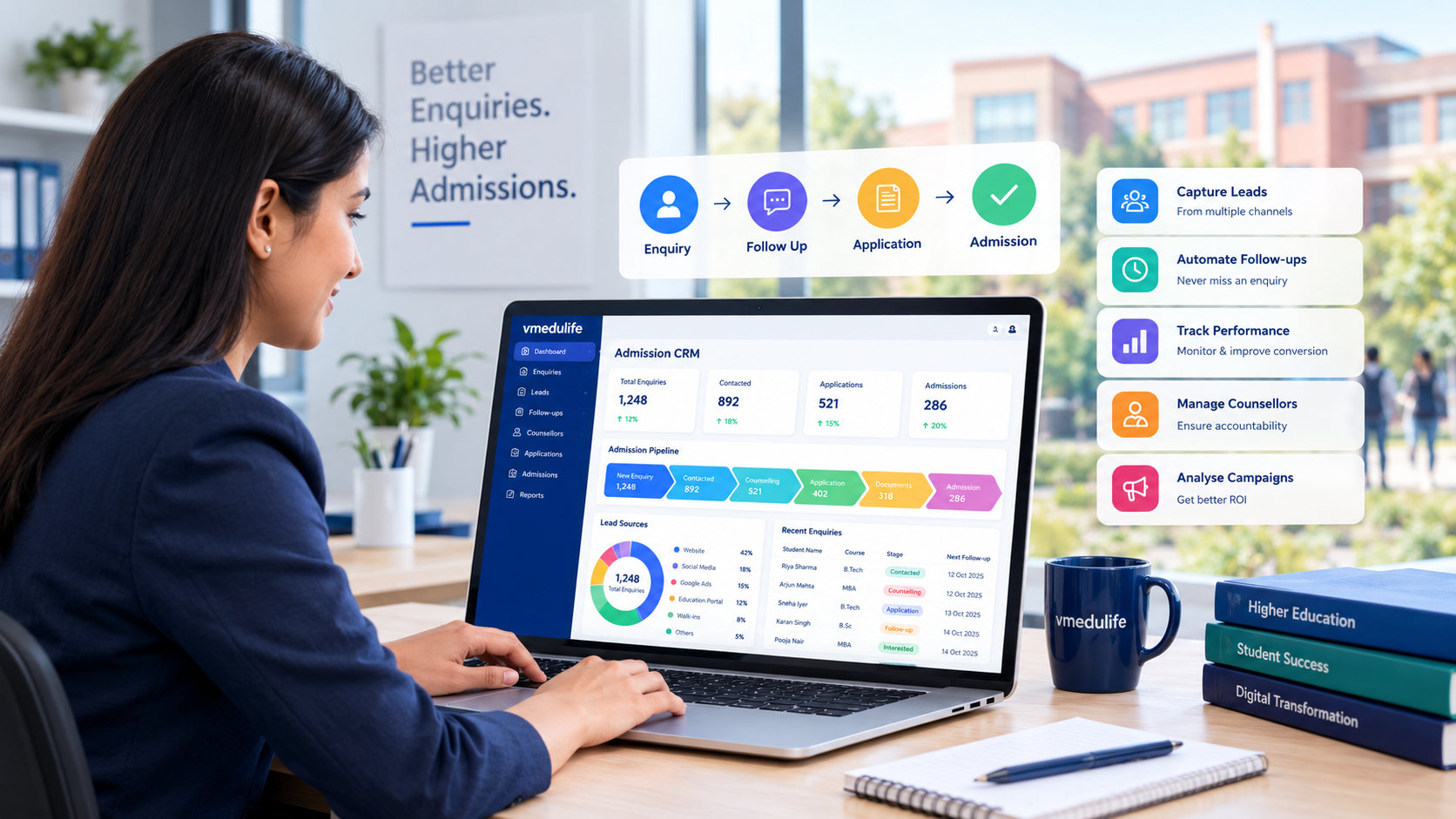
Admission pipeline and conversion tracking.
Counsellor performance analysis.
Admission campaign performance reports.
Instead of depending on individual spreadsheets or personal communication records, institutions gain complete visibility into their admission activities.
2. Why Do Colleges Need Admission CRM Software?
Consider a college with an annual intake capacity of 200 students and an average annual fee of ₹1,00,000.
Its potential first-year admission revenue is ₹2 crore.
Even a small improvement in admission conversion can have a significant financial impact.
For example, improving admissions by just 10 additional students can generate ₹10 lakh in additional first-year fee revenue.
Without a systematic admission management process, institutions may experience:
Enquiries that never receive a follow-up.
Prospective students choosing competing institutions.
Duplicate enquiry records.
Lack of accountability among admission counsellors.
No visibility into lead conversion performance.
Difficulty identifying which marketing campaigns generate admissions.
Admission CRM helps institutions reduce these operational gaps and improve admission efficiency.
3. Essential Features of an Effective Admission CRM
A. Centralized Lead Management
Collect student enquiries from multiple sources, including websites, social media campaigns, digital advertisements, telephone calls, walk-ins, and QR code forms.
All enquiry records are maintained in one centralized system, ensuring that no prospective student is overlooked.
B. Automated Follow-Up Management
Timely communication plays a major role in student admission decisions.
An Admission CRM helps counsellors schedule follow-ups, maintain communication history, and identify pending enquiries.
This ensures that every prospective student receives appropriate attention throughout the admission journey.
C. Lead Allocation and Counsellor Management
Institutions can distribute enquiries among admission counsellors based on predefined allocation rules.
Management can monitor:
Total enquiries assigned.
Enquiries contacted.
Follow-ups completed.
Applications received.
Admissions confirmed.
Counsellor-wise conversion ratios.
This creates transparency and accountability within the admission team.
D. Admission Funnel and Conversion Analytics
An effective Admission CRM should provide a clear picture of the admission pipeline.
For example, the admission process can be divided into the following stages:
- New Enquiry
- Contacted
- Counselling Completed
- Interested
- Application Submitted
- Documents Verified
- Admission Confirmed
Management can identify where prospective students are dropping out and take corrective action.
E. Marketing Campaign Performance
Institutions spend money on Google Ads, Meta Ads, education portals, exhibitions, and other promotional activities.
An Admission CRM helps identify which campaigns generate enquiries, applications, and confirmed admissions.
This enables management to allocate marketing budgets more effectively and focus on campaigns that deliver measurable results.
4. How Admission CRM Software Can Improve College Revenue?
Admission CRM is not simply an administrative tool. It can directly influence institutional revenue.
Consider the following illustrative scenario:
| Particulars | Value |
|---|---|
| Annual intake capacity | 200 students |
| Average annual fee | ₹1,00,000 |
| Potential annual fee revenue | ₹2,00,00,000 |
| Additional admissions through improved conversion | 10 students |
| Additional first-year revenue | ₹10,00,000 |
A structured admission process can help institutions recover opportunities that might otherwise be lost because of delayed responses, missed follow-ups, or poor lead management.
The objective is not merely to generate more enquiries, but to convert a higher percentage of existing enquiries into admissions.
Actual results depend on enquiry quality, course demand, competition, fee structure, and the effectiveness of the institution’s admission process.
5. Why Is Excel Not Enough for Managing College Admissions?
Excel is useful for maintaining basic student information, but it is not designed to manage a dynamic admission pipeline.
Consider the differences between spreadsheet-based admission management and dedicated Admission CRM software.
| Excel-Based Management | Admission CRM Software |
|---|---|
| Manual data entry | Centralized lead capture |
| Individual follow-up tracking | Structured follow-up management |
| Difficult to monitor counsellors | Counsellor performance tracking |
| Limited real-time reporting | Admission analytics and reports |
| Scattered communication records | Organized communication history |
| Manual conversion calculations | Admission funnel analysis |
| Difficult campaign attribution | Source-wise lead analysis |
As enquiry volumes increase, spreadsheet-based processes become increasingly difficult to manage.
A dedicated Admission CRM helps institutions organize their workflows, maintain better records, and improve coordination between admission teams.
6. How vmedulife Admission CRM Helps Educational Institutions?
vmedulife provides digital solutions designed around the operational requirements of educational institutions.
Its Admission CRM helps institutions organize their prospective student management process through features such as:
Centralized admission enquiry management.
Digital enquiry collection forms.
QR code-based lead collection.
Lead assignment and tracking.
Follow-up and communication management.
Admission pipeline monitoring.
Counsellor performance analysis.
Campaign-wise enquiry analysis.
Admission conversion reporting.
By digitizing admission operations, institutions can improve coordination between marketing teams, admission counsellors, and management.
For example, when a prospective student submits an enquiry, the admission team can track the enquiry, plan the next follow-up, record communication, and monitor the student’s progress toward application and enrolment.
Management can use admission reports to understand enquiry volumes, identify pending follow-ups, and evaluate the performance of admission campaigns.
The objective is to create a measurable and accountable admission process rather than relying on disconnected manual activities.
7. What Should Colleges Consider Before Selecting Admission CRM Software?
Before implementing an Admission CRM, institutions should evaluate the following factors.
1. Ease of Use
Can admission counsellors operate the system without extensive technical training?
An easy-to-use interface helps teams adopt the software more effectively.
2. Lead Integration
Can enquiries be collected from different digital and offline sources?
Institutions should evaluate whether the CRM supports their existing lead generation channels and whether additional integrations are required.
3. Follow-Up Automation
Does the system support reminders and structured follow-up activities?
Effective follow-up management helps admission teams respond to prospective students in a timely manner.
4. Reporting and Analytics
Can management monitor enquiry-to-admission conversion?
Look for reports that help identify pending enquiries, counsellor performance, lead sources, and admission pipeline progress.
5. Scalability
Can the software support multiple courses, campuses, and admission cycles?
A scalable system can accommodate changing institutional requirements.
6. Data Security
Does the solution provide appropriate access controls and data protection?
Institutions should review user permissions, data handling practices, backup procedures, and applicable data protection requirements.
7. ERP Integration
Can admission data be transferred into the Student Information System after confirmation?
Integration with an Education ERP can help reduce repeated data entry and improve continuity between admissions and subsequent academic operations.
Choosing the right solution ensures that admission management becomes a long-term institutional capability rather than just another software installation.
8. The Future of College Admissions Is Data-Driven
The education sector is becoming increasingly competitive. Students have access to more institutions, more information, and more choices than ever before.
Colleges can no longer depend entirely on traditional admission practices.
Institutions need to understand student behaviour, respond quickly to enquiries, monitor conversion performance, and optimize their marketing investments.
Admission CRM software helps institutions move toward a more structured and measurable approach.
With better access to admission data, management can identify which courses attract the most enquiries, which lead sources perform effectively, and where improvements are needed in the admission process.
Institutions can also use historical admission data to plan future campaigns, allocate counsellor resources, and establish realistic admission targets.
Admission CRM is becoming an important part of the digital infrastructure of modern educational institutions.
Conclusion
Every student enquiry represents a potential admission opportunity. Losing track of even a small percentage of these enquiries can affect an institution’s admission targets and financial performance.
An Admission CRM provides the visibility, accountability, and structured workflows required to manage these opportunities effectively.
With vmedulife Admission CRM, educational institutions can move from spreadsheet-based enquiry management to a centralized, measurable, and digitally managed admission process.
By improving lead tracking, organizing follow-ups, monitoring counsellor performance, and analysing admission conversions, colleges can build a more efficient admission management strategy.
Stop losing admission opportunities. Start managing every enquiry with intelligence.
Explore vmedulife Admission CRM and build a smarter admission management process for your institution.
Website : https://www.vmedulife.com/
Frequently Asked Questions (FAQs)
1. What is Admission CRM software for colleges?
Admission CRM software helps colleges manage student enquiries, track admission leads, schedule follow-ups, monitor applications, and manage prospective students throughout the admission process.
2. How does Admission CRM improve student admission conversion?
It helps admission teams respond to enquiries, organize follow-ups, identify pending leads, and monitor each student’s progress through the admission pipeline.
3. Can Admission CRM software replace Excel for admission management?
Yes. A dedicated Admission CRM can replace many spreadsheet-based admission workflows by providing structured lead management, follow-up tracking, communication records, and admission reports.
4. Is Admission CRM suitable for engineering colleges?
Yes. Engineering colleges can use Admission CRM to manage course-specific enquiries, entrance examination-related queries, counselling activities, applications, and admission follow-ups.
5. Can Admission CRM track the performance of admission counsellors?
Yes. Depending on its features, an Admission CRM can help management evaluate assigned enquiries, completed follow-ups, applications received, and confirmed admissions for individual counsellors.
6. Does Admission CRM help track marketing campaign performance?
Yes. When appropriate tracking and integrations are configured, institutions can analyse enquiries and admissions by lead source or marketing campaign to understand which activities generate results.
7. Can Admission CRM integrate with college ERP software?
Integration capabilities depend on the selected solution. When supported, connecting Admission CRM with college ERP software can reduce duplicate data entry and simplify the transfer of confirmed student information into academic systems.
8. How can colleges choose the best Admission CRM software?
Colleges should evaluate lead capture, follow-up management, reporting, ease of use, integration options, scalability, data security, and vendor support before selecting an Admission CRM.