ERP Most Popular : 10 Popular ERP Solutions Every College and University Should Know
Choosing the right Enterprise Resource Planning (ERP) software can significantly influence how an organisation manages its daily operations. From financial management and human resources to reporting and administration, ERP software helps businesses coordinate important processes through connected applications.
But when it comes to educational institutions, the requirements are more specialised. Colleges and universities must manage admissions, student information, academic activities, examinations, fees, faculty, and campus operations alongside traditional administrative functions.
This is why many decision-makers search for the ERP most popular solutions before selecting a platform for their institution. They want to understand which ERP systems are widely recognised, what capabilities they offer, and which provider can meet their operational requirements.
In this guide, we explore 10 popular ERP solutions, compare their general areas of focus, and explain how educational institutions can select the right ERP platform. We also introduce vmedulife, an education ERP solution designed to support academic and administrative management.
What Makes an ERP System Popular?
An ERP system becomes popular for different reasons. Some platforms are recognised because of their enterprise capabilities, while others are known for industry-specific functionality, flexibility, or cloud-based deployment.
However, popularity alone does not determine whether an ERP system is suitable for your organisation.
When evaluating ERP software, consider these factors:
Functional coverage : Does it support the processes your organisation needs?
Ease of use : Can employees, administrators, and other users operate it comfortably?
Scalability: Can the platform support future organisational growth?
Integration : Can it connect with existing applications and services?
Reporting: Does it provide useful information for management decisions?
Implementation : Does the provider offer a clear deployment and training approach?
Support : Are technical assistance and product updates available?
Total cost : Does the investment match your long-term requirements?
For colleges and universities, education-specific capabilities should also be part of the evaluation.
ERP Most Popular : 10 ERP Solutions to Explore
The following platforms are recognised names in the ERP and enterprise software market. They serve different industries and operational requirements, so this list is an overview rather than a ranking.
1. SAP
SAP is one of the most recognised enterprise software providers. Its ERP offerings, including SAP S/4HANA, support complex business processes across finance, procurement, manufacturing, supply chain, and other enterprise functions.
Key areas of focus :
Enterprise resource planning
Financial management
Procurement and supply chain
Business operations
Enterprise reporting
Who may consider it?
Large organisations with complex operational structures may evaluate SAP for enterprise-wide management.
Educational institutions should check how the proposed solution addresses admissions, student records, academic management, and examinations, including whether additional applications are required.
2. Oracle
Oracle offers enterprise applications covering financial management, procurement, planning, and operational processes. Its portfolio also includes solutions relevant to higher education, such as PeopleSoft Campus Solutions.
Key areas of focus :
Financial management
Procurement
Enterprise planning
Business operations
Higher education applications
Who may consider it?
Organisations seeking enterprise-level financial and operational capabilities may evaluate Oracle. Universities should identify the specific Oracle products being proposed and assess their coverage of student and academic administration.
3. Microsoft Dynamics 365
Microsoft Dynamics 365 combines business applications for areas such as finance, operations, customer engagement, and other organisational processes.
It can be relevant to institutions already using Microsoft technologies and services.
Key areas of focus :
Finance and operations
Business process management
Customer relationship management
Reporting and analytics
Microsoft ecosystem integration
Who may consider it?
Institutions looking for business applications within the Microsoft ecosystem may explore Dynamics 365. They should separately verify education-specific functionality and the need for additional applications.
4. Workday
Workday is known for cloud-based enterprise applications, particularly in human capital management and financial management. Its solutions are also used by higher education organisations.
Key areas of focus :
Human resource management
Financial management
Workforce planning
Reporting and analytics
Cloud enterprise applications
Who may consider it?
Universities looking to manage workforce and financial processes may consider Workday. They should also evaluate how their student administration and academic workflows will be supported.
5. Ellucian
Ellucian focuses on higher education technology and provides software for colleges and universities.
Its solutions address institutional processes and student-related administration, making it a relevant name when comparing education-focused ERP platforms.
Key areas of focus :
Higher education administration
Student information management
Academic processes
Institutional operations
Education technology
Who may consider it?
Colleges and universities seeking software designed around higher education requirements may evaluate Ellucian’s available products and modules.
6. Unit4
Unit4 provides enterprise software for service-oriented organisations, including solutions relevant to education and the public sector.
Its ERP capabilities include financial and human resource management, planning, and reporting.
Key areas of focus :
Financial management
Human resources
Enterprise planning
Reporting
Organisational operations
Who may consider it?
Educational institutions with complex financial and administrative requirements may consider Unit4. They should verify the coverage of student lifecycle and academic management processes.
7. Jenzabar
Jenzabar is an education technology provider serving colleges and universities. Its solutions are designed to support higher education administration and institutional processes.
Key areas of focus :
Higher education management
Student information
Academic administration
Institutional processes
Education-focused applications
Who may consider it?
Colleges and universities looking for specialised higher education software can evaluate Jenzabar based on its product coverage, implementation requirements, and institutional suitability.
8. Odoo
Odoo is a modular business management platform offering applications for accounting, sales, purchasing, inventory, human resources, and other business functions.
Its modular approach allows organisations to select applications based on their requirements.
Key areas of focus :
Accounting and finance
Inventory management
Purchasing
Human resources
Business operations
Who may consider it?
Organisations looking for modular business management software may explore Odoo. Educational institutions should assess whether the available applications or required customisations can support their academic and student administration needs.
9. Oracle NetSuite
Oracle NetSuite is a cloud-based business management platform that supports financial management, accounting, inventory, and other operational activities.
Key areas of focus :
Cloud-based ERP
Financial management
Accounting
Inventory and order management
Business reporting
Who may consider it?
Growing organisations looking for cloud-based business management capabilities may evaluate NetSuite. Colleges should verify whether additional education applications are needed for student records, examinations, and academic processes.
10. vmedulife
For educational institutions, an ERP platform should address the specific requirements of academic and campus administration.
vmedulife is an education ERP and campus technology provider established in 2013. Its platform supports colleges, universities, and other educational institutions through software modules designed around academic and administrative operations.
Rather than focusing only on traditional business functions, vmedulife enables institutions to explore a combination of education-focused capabilities.
Key areas of focus :
Admission CRM
Student Information System
Academic Management
Attendance Management
Learning Management System
Examination Management System
Outcome-Based Education
Fee Management
HRMS and Payroll
Library and Office ERP
Reports and Analytics
The relevant modules and workflows can be evaluated according to institutional requirements and selected configuration.
Who may consider it?
Colleges, universities, autonomous institutions, and other educational organisations looking for education-focused ERP and campus management capabilities can explore vmedulife.
Comparison of Popular ERP Solutions
The following comparison highlights the general focus of the platforms discussed.
| ERP Software | Primary Focus | Suitable Evaluation Area |
|---|---|---|
| SAP | Enterprise management | Complex business operations |
| Oracle | Enterprise applications | Finance and higher education requirements |
| Microsoft Dynamics 365 | Business applications | Finance and operational processes |
| Workday | Finance and HR | Workforce and financial management |
| Ellucian | Higher education | College and university administration |
| Unit4 | Service-oriented ERP | Finance and organisational operations |
| Jenzabar | Higher education | Student and academic administration |
| Odoo | Modular business management | Customisable business processes |
| Oracle NetSuite | Cloud business management | Finance and accounting |
| vmedulife | Education ERP | Academic and campus management |
The best option depends on the institution’s requirements, product edition, available modules, implementation approach, and budget.
Which ERP Features Are Important for Colleges and Universities?
A college or university should not select ERP software based only on its popularity. It should evaluate whether the platform can support the institution’s complete operational requirements.
Here are some important capabilities to consider.
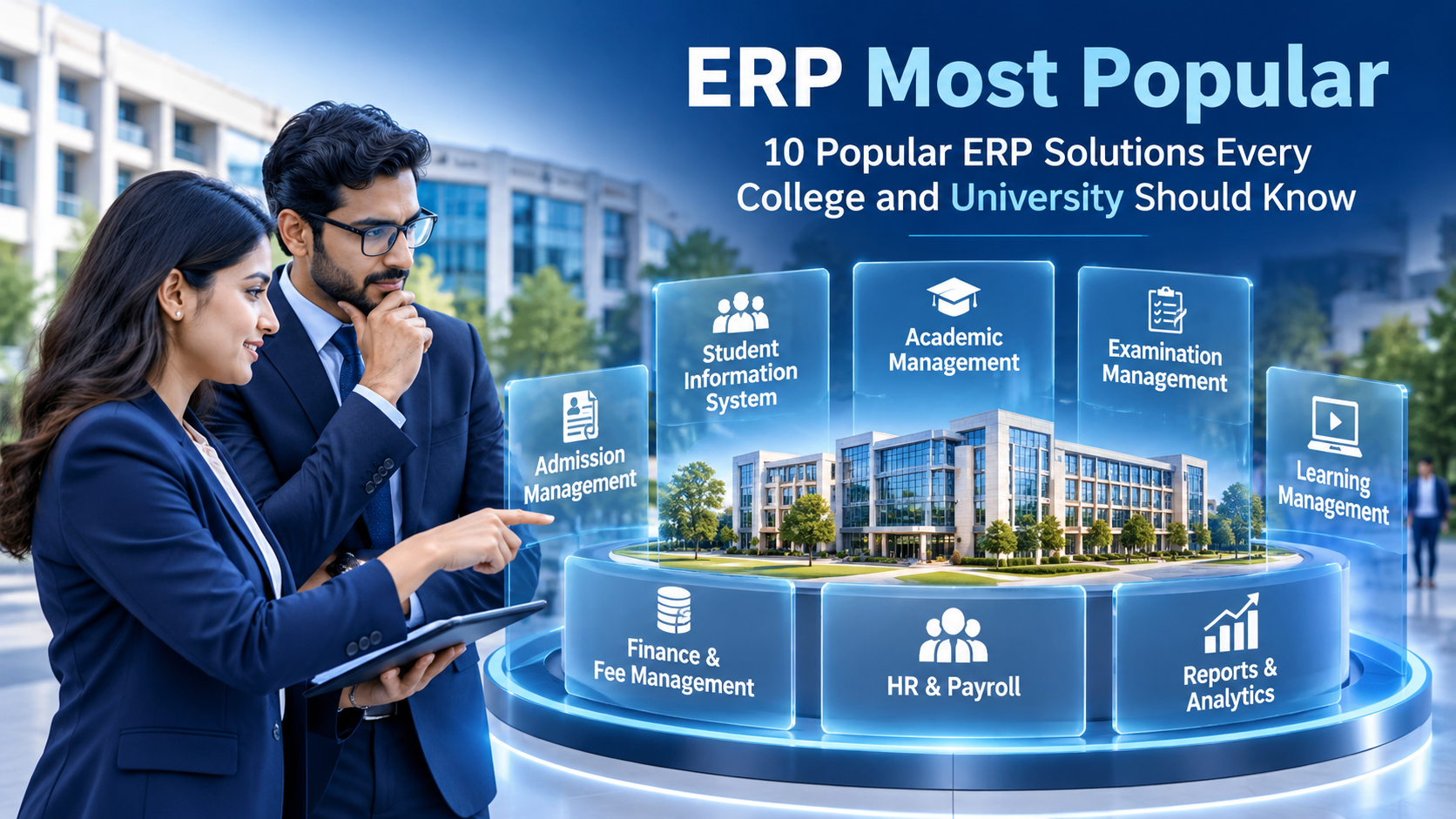
1. Admission Management
Managing admission enquiries, applications, counsellor activities, and follow-ups can become challenging when information is scattered across spreadsheets and separate applications.
An Admission CRM can help institutions organise enquiries, track admission stages, and manage communication with prospective students.
2. Student Information Management
A Student Information System helps maintain student profiles and relevant academic and administrative records.
Institutions should evaluate student registration, profile management, attendance information, and access to academic records.
3. Academic Management
Academic management capabilities help institutions organise academic activities, schedules, and related processes.
This can improve coordination between academic departments, faculty, and administrators.
4. Examination Management
Examinations involve multiple activities, including question paper preparation, hall tickets, seating arrangements, evaluation, grading, and result processing.
An Examination Management System can support these workflows and reduce repetitive administrative work.
5. Learning Management
A Learning Management System supports digital learning activities, learning resources, assessments, and communication between faculty and students.
6. Finance and Fee Management
Institutions need accurate information about fee structures, collections, pending payments, and financial activities.
ERP-based finance and fee management capabilities can help authorised teams manage these processes more effectively.
7. HR and Payroll
Faculty and employee management involves maintaining employee information, attendance, leave, payroll-related records, and other HR activities.
An HRMS can help institutions organise these responsibilities.
8. Reporting and Analytics
Management teams need reliable information to evaluate institutional performance.
Reports and analytics can help decision-makers review admissions, attendance, examinations, fees, and other operational indicators.
How to Select the Right ERP Software for Your Institution?
Before finalising an ERP provider, follow a structured evaluation process.
Step 1 : Identify your operational challenges.
List the activities that consume excessive time, involve repeated data entry, or create reporting difficulties.
Step 2 : Define your ERP requirements.
Separate essential features from optional requirements. This will help you avoid paying for unnecessary functionality.
Step 3 : Shortlist relevant ERP providers.
Compare general enterprise platforms and education-focused solutions according to your requirements.
Step 4 : Request product demonstrations.
Ask vendors to demonstrate real institutional workflows rather than showing only generic dashboards.
Step 5 : Evaluate implementation and support.
Discuss data migration, configuration, user training, technical support, and post-implementation assistance.
Step 6 : Compare long-term costs.
Review subscription or licensing charges, implementation, customisation, integration, training, and future expansion costs.
Step 7 : Involve the actual users.
Include administrators, faculty, finance teams, examination departments, and IT representatives in the evaluation.
Why Consider vmedulife for Education ERP?
If your institution is comparing the ERP most popular platforms, it is important to look beyond brand recognition and evaluate whether a system understands educational operations.
vmedulife provides an education-focused platform that brings together different academic and administrative requirements.
Institutions can explore relevant modules for admissions, student information, academic management, examinations, learning, OBE, HRMS, and campus administration.
The objective is to help institutions reduce fragmented processes, improve access to institutional information, and support better coordination between departments.
The right combination of modules should be identified through a detailed discussion about your institution’s requirements.
Conclusion : Popularity Matters, but Institutional Fit Matters More
The ERP market includes several recognised providers, from enterprise platforms such as SAP and Oracle to higher education-focused providers such as Ellucian and Jenzabar.
However, the ERP most popular in the market may not necessarily be the right solution for your college or university.
Your institution needs a platform that supports its academic structure, student lifecycle, administrative processes, and future growth plans.
If you are looking for education-focused ERP software that can support admissions, student management, academics, examinations, and campus operations, explore what vmedulife has to offer.
Ready to evaluate an ERP solution for your institution?
Request a personalised vmedulife demo and discover how the relevant modules can support your college or university’s operational requirements.
Website: https://vmedulife.com/
Frequently Asked Questions (FAQs)
1. Which ERP software is most popular?
SAP, Oracle, Microsoft Dynamics 365, Workday, Ellucian, Unit4, Jenzabar, Odoo, and Oracle NetSuite are among the recognised ERP and enterprise software platforms. Their suitability depends on the organisation’s requirements and industry.
2. What are the most popular ERP systems for educational institutions?
Educational institutions may evaluate higher education-focused providers such as Ellucian and Jenzabar, as well as enterprise providers such as Oracle, Workday, and Microsoft. Education ERP platforms such as vmedulife are also worth considering for academic and campus management requirements.
3. Is the most popular ERP always the best choice?
No. Popularity does not guarantee suitability. Institutions should compare features, implementation, integration, scalability, support, and total cost before selecting an ERP system.
4. What is the difference between business ERP and education ERP?
Business ERP generally focuses on functions such as finance, HR, inventory, and operations. Education ERP also addresses specialised institutional processes such as admissions, student information, academic management, examinations, and learning.
5. What features should a college ERP system include?
A college ERP may include Admission CRM, Student Information System, academic management, attendance, LMS, examination management, fee management, HRMS, library management, and reports and analytics.
6. How much does ERP software cost for a university?
ERP pricing depends on the provider, number of users, selected modules, deployment model, implementation complexity, integrations, training, and support requirements. Institutions should request a detailed quotation based on their needs.
7. Can ERP software support multiple college campuses?
Some ERP platforms support multi-campus operations. Institutions should confirm campus-level access, reporting, permissions, data management, and configuration options with the vendor.
8. Why should educational institutions consider vmedulife?
vmedulife provides education ERP and campus technology solutions covering areas such as admissions, student information, academics, examinations, OBE, LMS, HRMS, and office administration. Institutions can request a demo to evaluate the modules relevant to their requirements.