
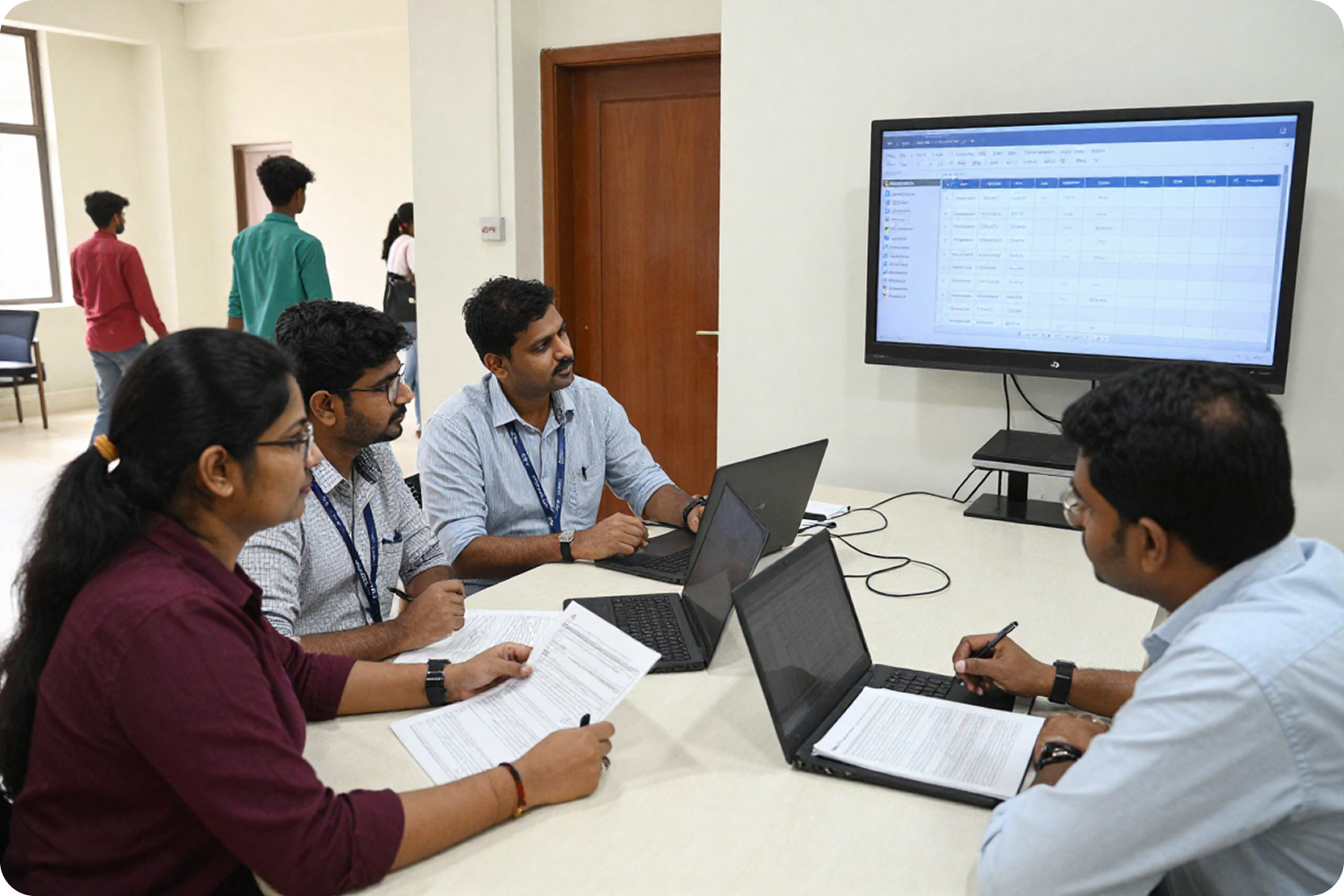
Rethinking Academic Evaluation : How Institutions Build Trust, Speed, and Insight with Digital Assessment Platforms?
Examinations shape academic credibility. They determine progression, graduation, employability, and institutional reputation. Yet, despite their importance, assessment operations in many institutions remain fragmented, manual, and reactive. Schedules are built in spreadsheets, eligibility is checked across disconnected systems, evaluations rely on paper workflows, and results often take weeks to finalize.
As student populations grow, programs diversify, accreditation demands intensify, and digital expectations rise, traditional exam management approaches struggle to scale. Institutions today require something far more powerful than exam software — they need a connected academic assessment ecosystem.
This is where a modern Examination and Assessment System becomes essential.
At vmedulife, assessments are designed not as isolated academic events, but as an integrated layer of institutional intelligence. Every exam process connects seamlessly with admissions, academics, learning delivery, finance, compliance, analytics, and student services — enabling institutions to govern assessments with speed, accuracy, transparency, and strategic insight.
This blog explores how advanced Examination and Assessment Systems are transforming education operations and why vmedulife’s approach is redefining academic evaluation for future-ready institutions.
What Is an Examination and Assessment System?
An Examination and Assessment System is a digital framework that manages and governs the full lifecycle of academic evaluations — from assessment design and exam scheduling to eligibility validation, exam execution, grading, moderation, result publishing, credential issuance, and compliance reporting.
Unlike basic exam tools that operate in silos, a modern system integrates tightly with:
Student Information Systems (SIS)
Learning Management Systems (LMS)
Academic calendars and curriculum frameworks
Faculty workload and HR operations
Finance, billing, and scholarship workflows
Accreditation and outcome measurement engines
Analytics and institutional intelligence platforms
Mobile portals and digital credentials
vmedulife embeds assessment workflows into its unified campus platform, ensuring that examinations become continuous governance processes rather than periodic administrative events.
Why Legacy Examination Models Are Failing Institutions?
Institutions that rely on manual or fragmented assessment processes face structural limitations that impact governance, compliance, and learner trust.
Operational Fragmentation
When scheduling, eligibility checks, evaluation, and results are handled across disconnected tools, data inconsistencies multiply. Departments operate independently, reconciliation becomes routine, and timelines slip.
Delayed Academic Outcomes
Manual valuation workflows stretch result publication cycles. Delays cascade into graduation schedules, placements, scholarship disbursements, and postgraduate admissions — directly affecting student futures.
Integrity and Compliance Risk
Unsecured question paper handling, decentralized evaluation, and manual moderation increase exposure to malpractice, tampering, and regulatory non-compliance.
Accreditation Pressure
Outcome-based education and quality assurance frameworks demand structured assessment data, traceability, and historical evidence — all difficult to compile manually.
Student Experience Erosion
Unclear exam communication, delayed hall tickets, opaque grading processes, and limited grievance visibility weaken trust and satisfaction.
A connected Examination and Assessment System replaces operational risk with predictable, governed, and auditable assessment processes.
The vmedulife Philosophy : Assessment as Institutional Infrastructure
vmedulife treats assessment as core academic infrastructure — not a peripheral workflow.
Every examination process connects seamlessly with:
Admissions and enrollment management
Academic planning and curriculum design
Faculty workload and HRMS
Attendance and eligibility governance
Learning delivery through LMS
Finance and revenue systems
Accreditation and compliance frameworks
Student services and alumni engagement
Institutional analytics and decision intelligence
This architecture transforms assessments into continuous feedback systems that strengthen academic quality, operational efficiency, and student confidence.
How vmedulife Restructures the Assessment Lifecycle?
1. Academic Assessment Design and Planning
Institutions configure assessment strategies aligned with curriculum frameworks, regulatory policies, and outcome-based education models. Academic calendars, grading schemes, moderation policies, and progression rules are centrally governed — ensuring consistency across departments, programs, campuses, and affiliations.
This flexibility enables institutions to evolve assessment frameworks without rebuilding systems.
2. Intelligent Exam Scheduling and Infrastructure Optimization
Instead of static timetables, vmedulife dynamically generates exam schedules by analyzing:
Student course registrations
Faculty availability and workloads
Classroom and lab capacity
Institutional policies and exam windows
Multi-campus operational constraints
Seating plans, invigilator assignments, and venue allocations are auto-optimized, reducing conflicts and improving exam preparedness at scale.
3. Automated Eligibility Validation and Registration
Eligibility verification — traditionally a manual, error-prone process — is automated using real-time integrations with:
Attendance management systems
Academic progression rules
Finance and fee compliance modules
Scholarship and concession frameworks
Regulatory and disciplinary policies
Eligible students receive digital hall tickets instantly via portals and mobile apps, while exceptions trigger workflow-driven resolution.
4. Secure Question Bank and Assessment Creation
Faculty and academic committees design assessments using structured question banks aligned with:
Learning outcomes
Course objectives
Difficulty distribution frameworks
Institutional assessment blueprints
Question papers move through encrypted workflows with role-based approvals, version control, and full auditability — ensuring security, consistency, and academic rigor.
5. Online, Offline, and Hybrid Exam Delivery
vmedulife supports diverse assessment models, including:
On-campus written exams
Digital MCQ and subjective tests
Practical and laboratory evaluations
Viva and oral assessments
Continuous internal assessments
Hybrid and remote examination formats
Through integration with vmedulife’s LMS and secure assessment interfaces, institutions conduct exams across environments without compromising integrity or governance.
6. Paperless Evaluation and Examiner Governance
Evaluation workflows are digitized through examiner dashboards that support:
Rubric-based grading
Annotation and moderation cycles
Automated script allocation
Faculty workload balancing
Quality checks and approval chains
Integration with HRMS and payroll ensures fair duty distribution, transparent performance tracking, and accurate compensation processing.
7. Rule-Based Grading and Result Publishing
Grading schemes, moderation thresholds, academic regulations, and progression rules are embedded directly into the system. vmedulife automates:
Mark and grade calculations
GPA and CGPA computation
Moderation adjustments
Pass/fail determination
Academic standing updates
Results pass through structured approvals before secure publication — drastically reducing turnaround time while preserving governance control.
8. Revaluation, Retotalling, and Academic Appeals
Students submit revaluation and retotalling requests digitally. vmedulife manages:
Application workflows
Fee collection through finance modules
Examiner reassignment
Timeline tracking and notifications
Result updates with full audit logging
This ensures fairness, transparency, and responsiveness without increasing administrative overhead.
9. Digital Transcripts, Certificates, and Credential Issuance
vmedulife automates the creation and distribution of:
Mark sheets
Grade cards
Academic transcripts
Degree certificates
Digital credentials
Verification-ready academic documents
Documents remain accessible throughout the student and alumni lifecycle, supporting employability, higher education mobility, and institutional reputation.
Outcome-Based Education and Continuous Academic Improvement
Modern institutions operate within outcome-based education frameworks that require measurable demonstration of learning effectiveness. vmedulife embeds outcome mapping directly into assessment workflows by enabling:
Question-to-course outcome alignment
Course-to-program outcome mapping
Automated attainment calculations
Learning gap identification
Cohort-level and program-level performance analysis
Continuous improvement feedback loops
Assessments evolve from grading tools into strategic academic optimization engines.
Accreditation, Audit, and Compliance Readiness
Accreditation frameworks demand structured, auditable evidence of academic performance, assessment quality, and learning outcomes. vmedulife continuously generates compliance-ready documentation by capturing:
Outcome attainment analytics
Assessment performance metrics
Curriculum evaluation data
Faculty assessment quality indicators
Student progression and completion trends
Governance approvals and audit trails
Institutions remain permanently audit-ready — eliminating reactive reporting cycles and reducing compliance risk.
Financial Integration Across the Assessment Lifecycle
Examinations involve complex financial workflows, including registration fees, late charges, revaluation payments, refunds, scholarships, and waivers. vmedulife integrates assessment governance directly with finance and ERP systems to enable:
Automated exam fee generation
Real-time payment reconciliation
Scholarship and concession processing
Revenue assurance and compliance reporting
Institutional financial analytics
This integration eliminates leakage while strengthening fiscal governance across academic operations.
Faculty, Examiner, and Invigilator Management
Assessment operations depend on faculty, examiners, moderators, and invigilators. vmedulife integrates assessment governance with:
Faculty expertise and qualification profiles
Availability and workload planning
Attendance, payroll, and HRMS systems
Performance evaluation and compliance frameworks
Institutions gain equitable workload distribution, transparent duty assignments, and accurate remuneration processing — while preserving academic accountability.
Student-Centered Assessment Experience
vmedulife reshapes the student experience by delivering:
Real-time exam schedules and notifications
Digital hall tickets and instructions
Transparent eligibility validation
Faster result publication
Online revaluation and grievance tracking
Secure transcript and certificate downloads
Mobile-first academic services
This creates a high-trust assessment environment where students feel informed, supported, and confident in institutional processes.
AI-Driven Assessment Intelligence
Beyond automation, vmedulife applies advanced analytics and AI to unlock deeper insights from assessment data, including:
Course-level difficulty patterns
Question effectiveness metrics
Pass-rate trends across cohorts
Faculty evaluation consistency indicators
Early identification of at-risk learners
Program-level attainment forecasting
Institutional benchmarking analytics
These insights enable leadership teams to act proactively, refine curricula, and improve learning outcomes with precision.
Multi-Campus, Multi-Affiliation, and Global Operations
vmedulife is architected for institutions operating across campuses, affiliations, geographies, and regulatory frameworks. The platform supports:
Centralized governance with localized autonomy
Multi-campus academic calendars
International grading frameworks
Diverse compliance regimes
Multi-language environments
Cross-border credentialing
This enables institutions to scale assessment operations without compromising consistency or regulatory alignment.
Enterprise-Grade Security and Academic Integrity
Assessment data represents institutional credibility. vmedulife protects academic integrity through:
Role-based identity and access control
End-to-end encryption of assessment content
Secure exam environments
Tamper-proof credential issuance
Continuous audit logging
Data privacy and sovereignty compliance
These safeguards ensure confidentiality, fairness, and trust across the assessment lifecycle.
Deep Integration Across the vmedulife Ecosystem
vmedulife’s Examination and Assessment System operates as part of a unified campus platform that includes:
Admissions and enrollment
Student Information Systems (SIS)
Learning Management Systems (LMS)
Academic planning and curriculum tools
University ERP and finance systems
HRMS and payroll
Attendance and compliance tracking
Hostel and transport operations
Placement and alumni management
Accreditation and quality assurance
Analytics and business intelligence
Mobile apps and digital experience platforms
This connected architecture eliminates silos, ensures real-time synchronization, and creates a single institutional source of truth.
Institutional Outcomes Achieved with vmedulife
Institutions deploying vmedulife’s Examination and Assessment System consistently realize:
Significant reduction in result processing timelines
Near elimination of manual grading errors
Improved accreditation readiness and audit outcomes
Higher student satisfaction and engagement
Reduced operational overhead
Greater academic transparency
Data-driven curriculum improvement
Scalable and future-proof assessment infrastructure
These outcomes position institutions to operate with confidence, agility, and academic excellence.
Why Institutions Choose vmedulife?
Institutions select vmedulife because it delivers:
A unified academic ecosystem rather than fragmented tools
Embedded outcome-based education governance
Continuous accreditation readiness
AI-powered academic performance insights
Secure, scalable, enterprise-grade architecture
Mobile-first student and faculty experience
Multi-campus and international readiness
Ongoing innovation aligned with education futures
vmedulife transforms assessments from administrative bottlenecks into strategic institutional capabilities.
The Road Ahead for Digital Assessment
Assessment models are evolving toward competency-based evaluation, continuous formative assessment, adaptive testing, AI-assisted grading, and verifiable digital credentials. Institutions increasingly require systems that can support:
Personalized learning pathways
Continuous outcome measurement
Real-time academic intervention
Global academic mobility
Lifelong learner records
Skills-based credentialing
vmedulife is built to support this evolution — enabling institutions to modernize assessment frameworks without operational disruption or governance compromise.
Final Reflection
A modern Examination and Assessment System is no longer optional — it is essential to institutional credibility, academic governance, compliance confidence, and learner success.
By embedding automation, intelligence, security, and transparency into every assessment workflow, vmedulife empowers institutions to deliver faster outcomes, stronger academic integrity, improved accreditation results, and superior student experiences — all while operating at enterprise scale.
If your institution is ready to move beyond fragmented assessment operations and embrace a connected, intelligent evaluation ecosystem, vmedulife provides the platform, insight, and scalability to make it happen.